
Teaching unit on the Holy Mysteries
This page is part of a teaching unit on the Holy Mysteries.
For an introductory lesson and links to the other Mysteries, please visit our page: The Holy Mysteries

OUR MATERIAL
Terms of use
Please note: The copyright of our work belongs solely to Orthodox Pebbles. We are offering our material to the public to be used as a whole, and only for classroom and personal use. This means we do not allow for users to break our material up into individual parts (images or text), and use those parts in their own creations – analog, digital, or online – even if these creations are only meant to be used for teaching. For example, a user is not permitted to include our material in any way in their own slideshows, worksheets or videos (local or in the “cloud”), even if they mention us as the source. If you are interested in creating a specific teaching activity with our material, please contact us – we may be able to create it instead, for the benefit of the whole Orthodox community.
Additionally, we love to see photos on social media of our creations being used. However, if you want to showcase our material in a different way on a website, newsletter, blog or social media post, please contact us first.
Finally, we kindly ask that you do not directly share the material you download from our website with others. Please point them to our website instead, so they can download it from here.
Thank you for being fair and respectful of our work!
FREE PRINTABLES

Click to download
(2.2 MB)
Printing problems? PLEASE CLICK HERE
TEACHING ABOUT HOLY UNCTION

Objectives
At the end of the lesson, the students should be able to:
Younger children
- Say the name “Holy Unction“.
- Mention that, during Holy Unction, we are anointed with holy oil for the healing of our soul and body.
- Explain that Holy Unction includes seven readings and seven prayers.
- Briefly retell the story of the healing of the blind man.
- Point to the main characters on the icon (our Lord, the blind man being healed, the Disciples).
Older children
In addition to the above, the older children should also be able to:
- Elaborate on the meaning of healing, pointing out that we should approach the Mystery of Holy Unction in the context of God’s will being fulfilled. God may not wish for the sick person to be bodily healed at that time, as sickness might be beneficial to them spiritually. It can help them grow in the virtues of trust in God, patience, obedience, and compassion for others.
- Explain that Holy Unction also brings forth spiritual healing. It doesn’t replace Holy Confession; rather, it complements it by forgiving sins that were unintentionally left out of Holy Confession, because they were forgotten or because the person never realized them (not sins that were not mentioned on purpose).
- Say that Holy Unction happens at church on Holy Wednesday afternoon, and can also occur privately at any time. They can also mention the objects that are required to perform Holy Unction at home.
- Explain that the symbol (= the physical manifestation of God’s grace) in Holy Unction is the holy oil.
- Make a Scriptural connection to the Mystery by discussing James 5: 14-16.
- Recite a phrase from one of the prayers of the service of Holy Unction.
- Point to the different scenes on the icon of the healing of the blind man and describe the events in each one.
Vocabulary: Unction, oil, healing, sin, forgiveness, body, soul

Planning the lesson
First, introduce the Mystery by doing one or both of the following activities.
Introducing Holy Unction
- Discuss a Bible story. Any of our Lord’s healing miracles is appropriate, but we find that the most effective ones are the ones where our Lord applied a substance on the sick person for the healing to take place. Those are the healing of the blind man in Mark 8:22-26 and the healing of the blind man in John 9:1-7. The connection to the Mystery can be made when it is discussed how God’s grace worked through a physical substance to bring health to the person.
The miracle in John 9 is especially appropriate for older children, as it also includes a discussion of the spiritual aspects of healing at the end. The blind man, after receiving bodily health, gradually receives spiritual health as well, ultimately recognizing our Lord as the Son of God and believing in Him (John 9: 8-38). *A very helpful explanation of how the blind man, who is a symbol of all humanity, gradually becomes a model of Christian witness is found in the Orthodox Study Bible, pages 1442-1443.
- Do the experiment described below. The parallels with Holy Unction are as follows: The drops of color are the sickness – the oil is the holy oil – the water is God’s grace. After the experiment is conducted, it can be explained that, just as the color gets dissolved in the water passing through the oil, the sickness is dissolved by God’s grace through the holy oil at Holy Unction.
After introducing the Mystery, the lesson could go as follows:
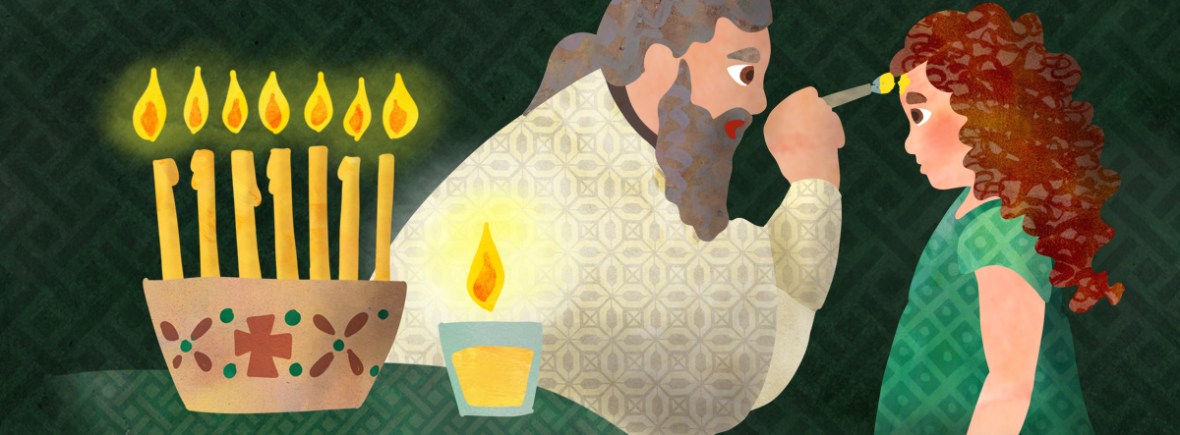
- Act out lighting the seven candles and anointing with holy oil. A bowl of flour can be prepared, where seven candles are placed one-by-one and then lit. Depending on the age of the children, while doing this, parts of the readings can also be read. Then, the teacher can use a cotton swab to show how the priest anoints us with oil. Another option would be for the children to show how the anointing is done on a doll. Please note: Such enactments can be useful when teaching young children, as they help make abstract concepts more concrete; however, care should be taken that they are always done in a reverent way.
While performing the enactment, the teacher can discuss the following points:
– The meaning of healing, its bodily and spiritual components.
– How and why we always ask for God’s will to be done and not for the sick person to necessarily be relieved from sickness immediately.
– The difference between Holy Unction and Holy Confession and why one Mystery complements – doesn’t replace – the other.
– The connection to James 5: 14-16.
– The times when Holy Unction is performed (at church and/or privately).
- Discuss the relevant icon.
- Work on reinforcement activities.
Introductory experiment
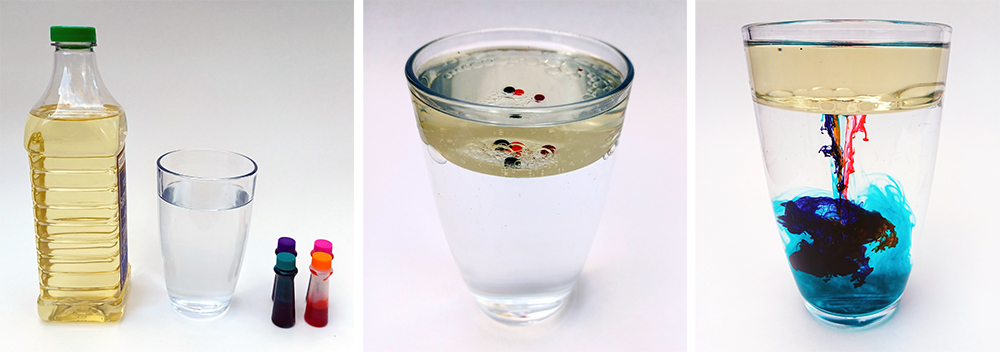
You will need:
- A clear container such as a tall glass or jar
- Water
- Vegetable oil
- Liquid food coloring
What to do:
- Fill the clear container about 4/5 with water.
- Carefully pour a thick layer of vegetable oil over the water until the container is almost full. Let the oil settle.
- Squeeze a few drops of food color on the surface of the oil.
- Wait.
- In a few minutes, the color will pass through the layer of oil and start dissolving into the water in a dramatic way.
Reinforcement activities
In the printable packet, we are offering the following activities:
- Fact sheet and corresponding worksheet (for the older children)
- Icon worksheet (one for the younger and one for the older children)
- Crossword puzzle
- Cut-and-glue activity (make the bowl of seven candles)
- Word puzzles (one for the younger and one for the older children)
- Board game
Helpful external resources
We are including below some links that we have found helpful for teaching about Holy Unction.
- Holy Unction Explanation for Kids – A comic strip-type printable page by Kristina Tartara of the blog “Raising Orthodox Christians”.
- Holy Unction printable – by Elenie Grasos of the blog “Orthodox Education”.

BACKGROUND
The Orthodox Church has always seen the soul and body as inseparable, and she wishes for both to be in good health. As the mystery of Holy Confession heals our soul, the Mystery of Holy Unction heals both body and soul. A verse in the Epistle of St. James reads, “And the prayer of faith will save the sick, and the Lord will raise him up. And if he has committed sins, he will be forgiven” (James 5:15). Faith here refers to the whole Church, who, by divine authority, is able to pray for and attain the healing of ailments both physical and spiritual.
In the Mystery of Holy Unction, the physical manifestation of God’s grace is the oil, which is prayed over and sanctified by the Holy Spirit. The priest anoints the sick person with the holy oil, and if it is God’s will, the sick person gets well. Since it is not always the will of God that physical healing occurs, the proper context of Holy Unction is the prayer of Christ that God’s will be done. Regardless of the occurrence of physical healing, through Holy Unction, the afflictions of the body are consecrated, and the sufferings of the person are united with the sufferings of Christ.
Holy Unction is performed in the church on Holy Wednesday afternoon. The service calls for seven priests, seven prayers, and seven Epistles and Gospel readings. When it is not practical for seven priests to be present, it can be officiated by as many priests as are available. As the Scriptures are read, seven candles are lit one by one in a bowl of flour or wheat signifying eternal life, with a bowl of the oil to be sanctified next to it. At the end of the service, the priest anoints the faithful, making the sign of the cross on the face (forehead, right cheek, left cheek, chin), and on both sides of each hand. The faithful kiss the priest’s hand and take a small cotton ball to wipe the rest of the face and hands; it can be saved or disposed of by burning. Ideally, one prepares for Holy Unction by going to Confession.
The service of Holy Unction can also be performed privately. In this case, a table should be dressed in a clean white cloth, and on it there should be an icon of Christ or the Theotokos, a lit vigil lamp, a bowl of pure extra virgin olive oil, a bowl of flour or wheat, and seven candles. After the service, the wheat can be made into kolyva for a memorial service; the flour can be made into a prosphoron for the Divine Liturgy.
The holy oil from Holy Unction can also be brought into hospitals for the anointing of the sick.
Scriptural references
Luke 10:25-37, Luke 19:1-10, Matthew 10:1, 5-8, Matthew 8:14-23, Matthew 25:1-13, Matthew 15:21-28, Matthew 9:9-13
James 5:10-16, Romans 15:1-7, 1 Corinthians 12:27-13:8, 2 Corinthians 6:16-7:1, 2 Corinthians 1:8-11, Galatians 5:22-6:2, 1 Thessalonians 5:14-23
The service of Holy Unction
Iconography

The icon of the healing of the blind man is helpful for teaching about Holy Unction. It is an icon where several scenes that took place at different times appear all at once. The main image in the forefront is that of Christ anointing the blind man’s eyes with clay. The Disciples are also pictured, framing the two main characters, excitedly watching and anticipating the healing miracle.
In the background, there are many smaller scenes, as if in a comic strip. First, we see the blind man washing off the clay from his face at the pool of Siloam. Then, he is pictured rejoicing, having received his sight. The next scene, taking place inside a building, is the questioning of the man by the Pharisees, that eventually leads to his open declaration of faith. Finally, on the right, there are the man’s parents, who are being summoned by the Pharisees to testify on his behalf.
EXPLORE FURTHER
- The Sacrament of Holy Unction, Greek Orthodox Archdiocese of America.
- Holy Unction, Orthodox Church in America
- Sunday of the blind man, Greek Orthodox Archdiocese of America
- Sunday of the blind man, Orthodox Church in America
- Sunday of the blind man, Antiochian Orthodox Christian Archdiocese of North America
 Orthodox Pebbles