
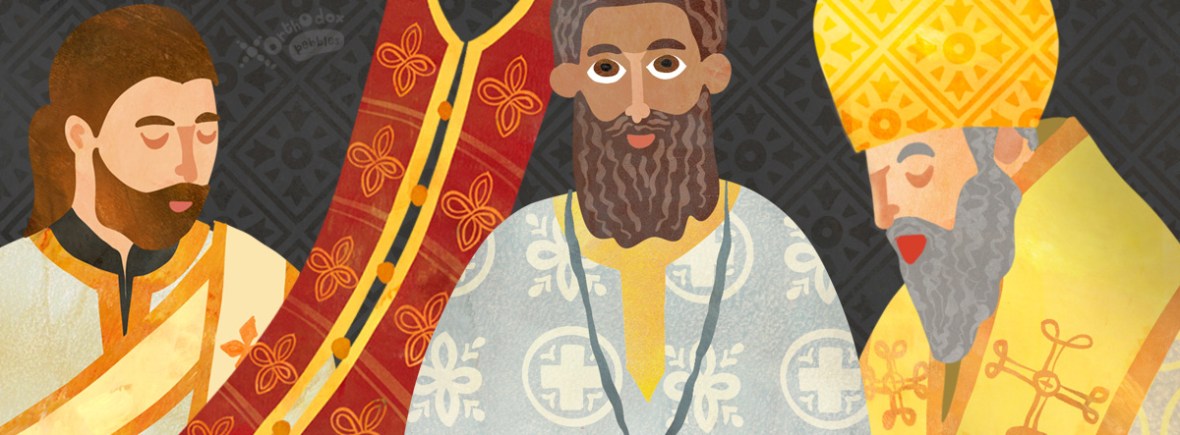
Teaching unit on the Holy Mysteries
This page is part of a teaching unit on the Holy Mysteries.
For an introductory lesson and links to the other Mysteries, please visit our page: The Holy Mysteries

OUR MATERIAL
Terms of use
Please note: The copyright of our work belongs solely to Orthodox Pebbles. We are offering our material to the public to be used as a whole, and only for classroom and personal use. This means we do not allow for users to break our material up into individual parts (images or text), and use those parts in their own creations – analog, digital, or online – even if these creations are only meant to be used for teaching. For example, a user is not permitted to include our material in any way in their own slideshows, worksheets or videos (local or in the “cloud”), even if they mention us as the source. If you are interested in creating a specific teaching activity with our material, please contact us – we may be able to create it instead, for the benefit of the whole Orthodox community.
Additionally, we love to see photos on social media of our creations being used. However, if you want to showcase our material in a different way on a website, newsletter, blog or social media post, please contact us first.
Finally, we kindly ask that you do not directly share the material you download from our website with others. Please point them to our website instead, so they can download it from here.
Thank you for being fair and respectful of our work!
FREE PRINTABLES
Click to download
(3 MB)
Printing problems? PLEASE CLICK HERE
TEACHING ABOUT HOLY ORDERS
Objectives
At the end of the lesson, the students should be able to:
Younger children
- Say the name Ordination or Holy Orders.
- Explain that Ordination is the mystery during which a man becomes a priest.
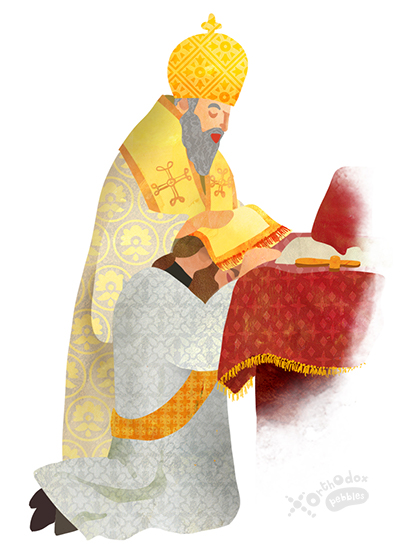
- State that, for a man to become a priest, the bishop – another priest ranking higher than him – must touch him on the head with his hands, while reciting special prayers. The Holy Spirit comes down through the bishop’s hands to the candidate being ordained.
- Point to Christ on the icon of Christ the Great Archpriest and explain that He is dressed as a bishop because He is always the Head of our Church.
- Mention that the faithful call out “Axios!“, declaring the candidate worthy to serve as clergy.
Older children
In addition to the above, the older children should also be able to:
- Explain that the laying of hands goes all the way back to the Apostles, and this is why our Church is called Apostolic.
- List the three orders of priesthood: deacon, presbyter, bishop – also mentioning their ranking.
- Discuss how the three orders of priesthood have different functions and we can tell them apart from their vestments.
- Describe some of the common elements in the rite of Ordination.
Vocabulary: Ordination, Holy Orders, Priest, Deacon, Presbyter, Bishop, Laying of hands, Apostolic, Axios.

Planning the lesson
Using our material and some external resources, a lesson on Ordination could go as follows:
First, introduce the Mystery. One idea could be to have one of the male students dress in an altar server robe. Explain the role of the altar server and why he is dressed that way and not in his regular clothes. Then show pictures of the three ranks of priesthood and have the children point out how their vestments are similar or different compared to what the child is wearing. (A very good resource explaining Orthodox clergy vestments can be found HERE). Explain that a person becomes a clergyman when the bishop places his hands on that man’s head and recites special prayers. The bishop himself becomes a bishop when the Patriarch (the highest clergy rank of all) places his hands on the prospective bishop’s head. The teacher can act that part out with the help of the child dressed in the robe.
External resources
Fun video
A fun way to introduce Holy Orders is to show the Ordination video by Rocko’s Music Factory, on the Ancient Faith Kids YouTube channel. You can pause at the different pictures and discuss the ranks of clergy as well.
Fantastic photos
This blog post by Kh. Destinie of Ascetic Life of Motherhood has wonderful photos of all the steps of the Mystery of Ordination. They can be very helpful in presenting and discussing what goes on in each phase.
After introducing the Mystery, the lesson could go as follows:
- Discuss what our priest does for us and, for older children, the difference in the functions of the three ranks of clergy.
- Act out the main parts of the rite of Ordination, using simple props. Stress the connection to the Apostles, and don’t forget to exclaim “Axios!”
- Discuss the icon of Christ the Great Archpriest.
- Work on reinforcement activities.
- Make a craft: Icon of Christ the Great Archpriest or priest peg doll
Reinforcement activities
In the printable packet, we are offering the following activities:
- Fact sheet and corresponding worksheet (for the older children)
- Crossword puzzle
- Word puzzles – one for younger and one for older children
- Worksheet: Orders of priesthood and their functions
- Board game
- Crafts: The icon of Christ the Great Archpriest and priest peg doll
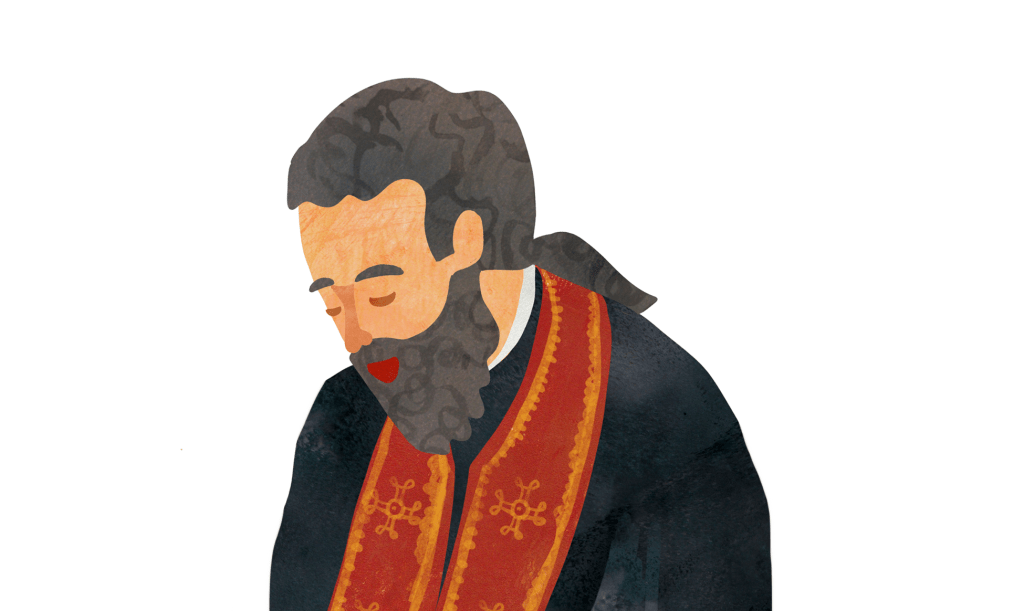
CRAFT: Priest peg doll
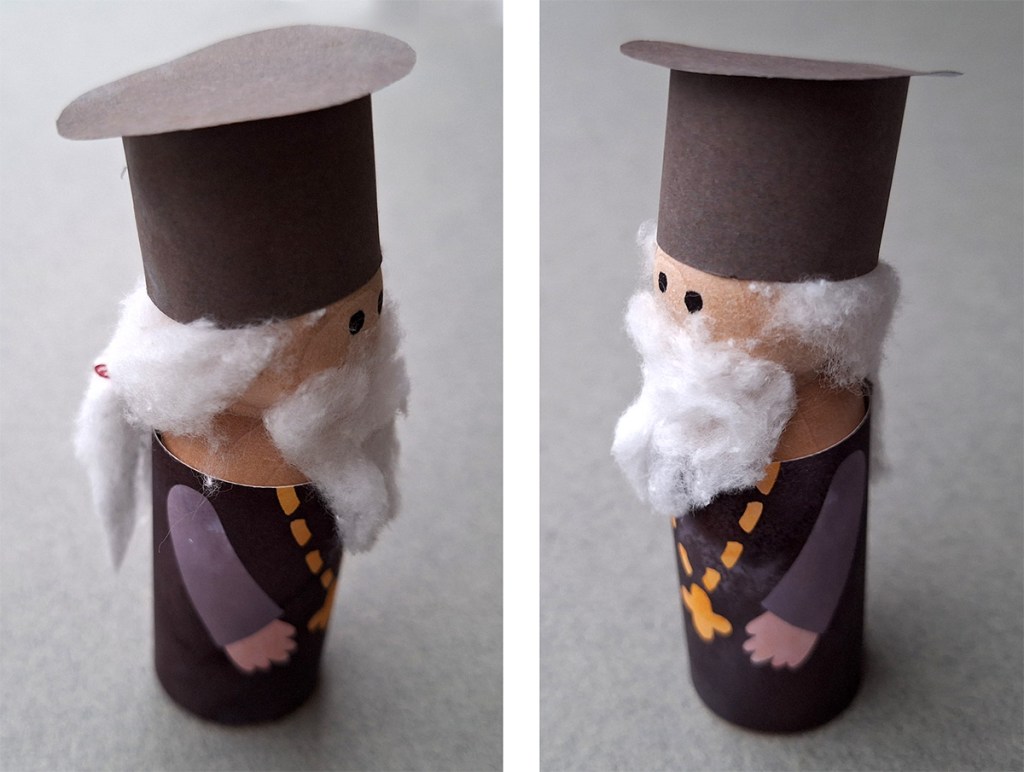
You will need:
- The templates from our printable packet.
- One peg doll (preferably 3.5″ tall, see printable packet).
- One or two cotton balls.
- Scissors, glue, Sharpie.

What to do:
To make the doll, cut out the templates. Wrap the larger rectangle around the body of the doll and glue in place. Roll the smaller rectangle into a cylinder, testing to make sure it is wide enough to fit partway down the top of the head, but not so wide as to fall around it. Secure the cylinder with a little glue. Glue this cylinder onto the back of the circle to make the hat.
Gently pull apart a cotton ball, flattening with your fingers, until you have a flat piece of cotton. Move it all around the head pushing down with your fingers, and use scissors to cut it into the appropriate shape. In the back, you can cut it or leave it longer, to make your priest have long hair. Do the same with another piece of cotton for the beard. Glue the hair and beard in place. Place the hat on top of the hair and draw the eyes using a Sharpie. READY!

BACKGROUND
The Orthodox Faith maintains the conviction that Christ is the only High Priest. Christ also cares for His Church, so He has granted the responsibility of shepherding His flock to those persons who feel His calling. In the Orthodox tradition, ordination is seen as an eternal “setting apart”, that cannot be revoked.
The physical manifestation in the mystery of Ordination is the ‘laying upon’ of the hands of the Bishop, and this comes directly from the Apostles. This is signified in the Greek name of the mystery, Cheirotonia / χειροτονία (chi-roh-toh-NEE-a), which literally means “stretching of hands”. The person being ordained must be kneeling in front of the bishop, and the bishop touching the candidate’s head. Part of what makes the Church ‘Apostolic’ is this physical touching from the bishop’s hand, going all the way back to the Apostles.
The priesthood includes three major orders: Deacon, priest, and bishop. In these levels of ordination there are ranks, which are not so much of authority as they are of function.
Bishop: The bishop is the leader of a diocese, which includes parishes, monasteries, and other Church properties within a region. He appoints priests and deacons to different parishes and serves as the chief liturgical celebrant. He also ordains suitable candidates to various Church ranks. The bishop himself is ordained by the Patriarch and other bishops, requiring at least one other bishop in addition to the Patriarch.
Priest: The priest is the leader of a parish and is responsible for all spiritual and material matters related to it. As the parish leader, the priest is the primary celebrant of the Divine Liturgy within the parish when the bishop is not present. He is assisted by lower-ranking clergy.
Deacon: The deacon holds the highest rank among the lower clergy (lower clergy ranks include subdeacon and reader). A deacon assists the priest in liturgical matters and other duties as needed. Deacons cannot celebrate the Divine Liturgy on their own; their role is inherently supportive. Deacons do not provide spiritual advice or hear confessions. If approached for spiritual matters, they are to direct individuals to the priest.
In Orthodoxy, qualified married men can be ordained as priests, but once a man is ordained as a priest while being single (celibate), he cannot marry. A decision about marrying or staying celibate must be made before ordination and cannot be altered afterward. Historically, this has been the Church’s stance since ancient times, with examples of married priests and even bishops dating back to the Apostles.
The ordination occurs within the Divine Liturgy, but at different times depending on the order. There are common elements in the rites for different orders:
- Being guided by fellow clergy
- Kneeling at the Altar
- “Laying on of hands”
- Receiving new vestments while the congregation declares “Axios!” (worthy)
- Taking on a new role in the Divine Liturgy
Scriptural references
Matthew 18:18, John 15:16, John 20:21-26, Acts 6:1-6, Acts 14:23, Titus 1:5-9, Romans 11:29, 1 Timothy 5:17, 2 Timothy 4:1-5
The Mystery of Ordination to the Diaconate
The Mystery of Ordination to the Priesthood
Iconography
An icon relevant to the mystery of Ordination is that of Christ the Great Archpriest.

Christ is depicted vested as a Bishop. He is blessing with his right hand, and holding the Gospel with the His left hand. On the Gospel, we read the phrase “My Kingdom is not of this world” (Η βασιλεία η εμή ουκ έστιν εκ του κόσμου τούτου).
Explore further
- Holy Orders – Orthodox Church in America
- Holy Orders – Greek Orthodox Church of the Assumption, Windham NY
- Priesthood: The Mystery of Ordination – Orthodox Church of St. John the Russian, Russian Orthodox Church Outside of Russia, Ipswitch MA
- Forms of Addresses and Salutations for Orthodox Clergy – Greek Orthodox Archdiocese of America
- Be the Bee #116, Our Sacred Order (Hierarchy in the Church), video by the Youth and Young Adults Ministries of the Greek Orthodox Archdiocese of America
- Good Guys Wear Black – A website by Fr. John A. Peck of the Russian Orthodox Church Outside Russia offering reflection, guidance, and information about the Holy Priesthood.
 Orthodox Pebbles